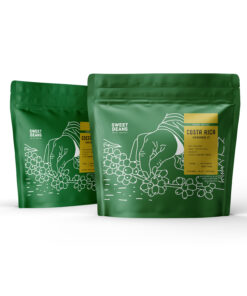

Costa Rica Las Lajas – Black Diamond | anaerobic honey
Price range: 20,00 € through 69,00 €
The Chacon farms are mostly run along organic farming principles. It has become more costly and complicated to gain official organic certification and the family felt that certification wasnt adding sufficient value to their product so they let their certification lapse. However, organic principles have remained fundamental to their farming philosophy, with a chemical-free production process, pulp from the mill being used to make compost for the coffee plants, and processes that use only one cubic meter of water per day.
Primary flavour note: Balsamic, sticky toffee, bubble gum, cherry blossom, rosehip
Costa Rica is a small country but the diversity of climates found there and their impact on coffee production has led to a coffee industry that punches above its weight. The first coffee was grown in the Central Valley a lush, fertile region influenced by Atlantic weather patterns and this is where Las Lajas coffee, which we have been buying since 2017, is grown by the Chacon family. Six farms owned by six brothers and together comprising 73ha and a mill are located in the town of Sabanilla de Alajuela, on the slopes of the Pos volcano. The mill stands at 1,300 masl and the farms above at 1,450-1,500 masl. The mill, which produces about 2,000 exportable bags per year, is owned and run by Oscar Chacon and his wife Francisca, with help from their four children the eldest of whom took the second level of the Q Processing course in 2020.
The Chacon farms are mostly run along organic farming principles. It has become more costly and complicated to gain official organic certification and the family felt that certification wasnt adding sufficient value to their product so they let their certification lapse. However, organic principles have remained fundamental to their farming philosophy, with a chemical-free production process, pulp from the mill being used to make compost for the coffee plants, and processes that use only one cubic meter of water per day.
Innovation is central to the farms, and the family has experimented with different coffee varieties. They now grow Caturra, Red and Yellow Catuai, Paraiso (Sarchimore and Catuai), Milenio, Villa Sarchi, Geisha, Pacamara and SL28.
The harvest here runs from December to February, and after harvest the coffees are floated using Penagos machines before being processed. The honeys are first dried on beds in the sun, being moved when the desired colour is reached the longer the drying, the darker the honey (black honey is not moved at all for the first two days after pulping). When they move the patios, they flip the crust formed rather than create rows with a rake as they have found this makes for a more consistent lot. They have given names to the different processes they have developed, including Alma Negra (we will have this fermantation also!), Perla Negra and Yellow Diamond.
Oscar and Francisca started working on their own but they now employ 20 people in the mill and up to 100 pickers.
| Weight | 0,200 kg |
|---|---|
| weight | 200 gr., 500 gr., 1000 gr. |
Related products