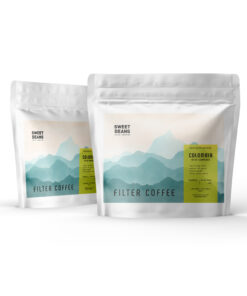
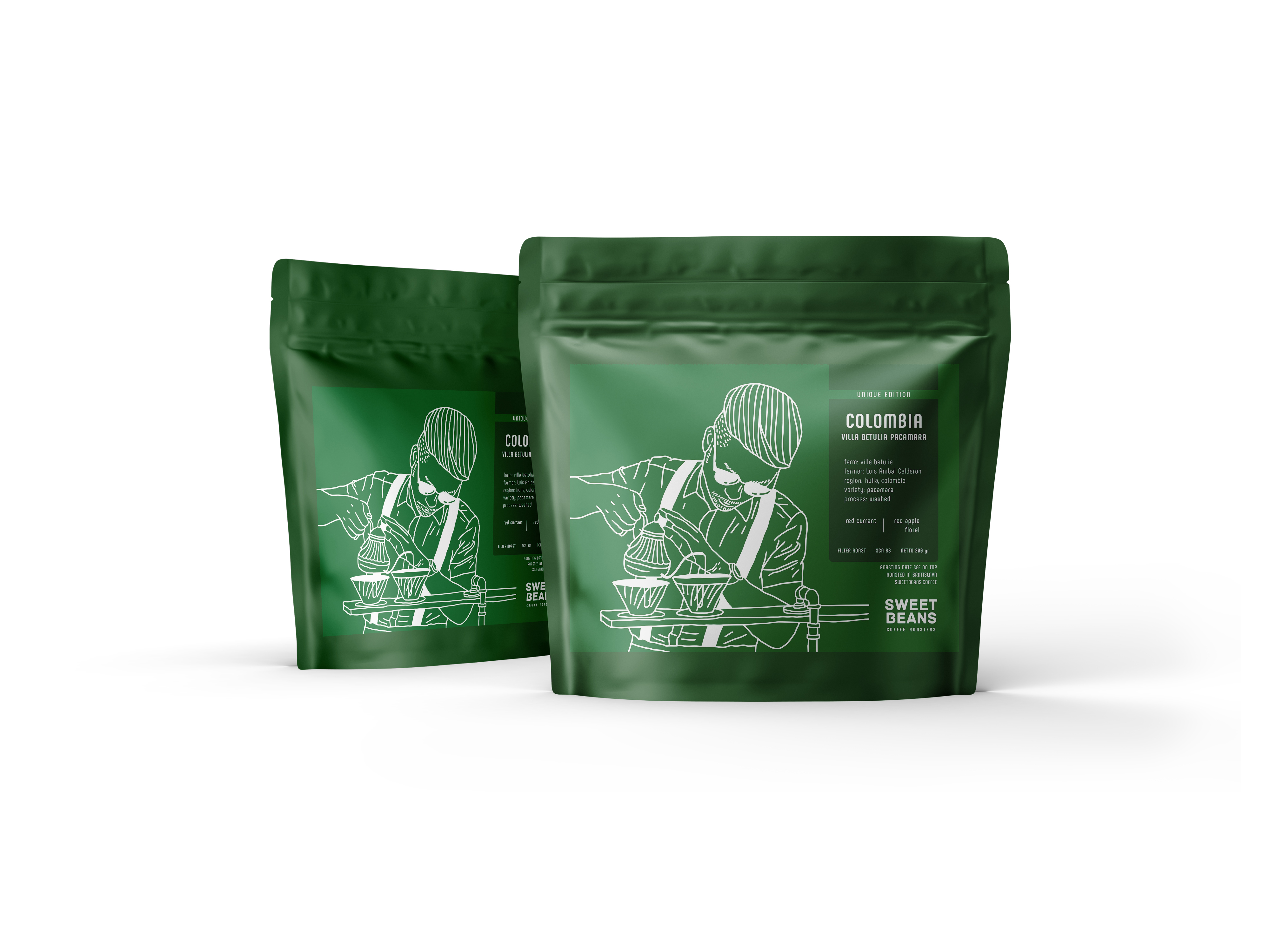
Colombia Villa Betulia | washed pacamara
Price range: 20,00 € through 89,00 €
This lot — Pacamara – is a cultivated hybrid of two well known coffee varieties Pacas and Maragogype. This cross was created in El Salvador by the Salvadoran Institute for Coffee Research in 1958 with the goal of combining the high yield and excellent cup quality of Pacas with the distinct, large bean size of Maragogype.
Villa Betulia sits in the highlands of Acevedo, Huila, and has become one of the most influential farms in Colombia’s specialty landscape. It’s run by Luis Aníbal Calderón, a second-generation producer whose story mirrors the trajectory of Colombian coffee itself. For decades, the farm cultivated traditional varieties under the constraints of the C-market. But in 2011, when prices reached a breaking point and the farm’s future hung in the balance, Luis chose a different path. Instead of stepping back, he pivoted—toward risk, toward flavor, toward the unknown.
In 2012, Luis planted his first 5,000 Gesha trees. Three years later, he began the bold transition of converting the entire farm to exotic varieties—at a time when most of Colombia was still focused on volume over differentiation.
Today, Villa Betulia grows more than 20 varieties, and Luis has become widely recognized for his precision-driven approach to processing. His mastery of extended fermentations and slow, controlled drying allows him to push boundaries while preserving clarity, structure, and integrity in the cup.
This lot — Pacamara – is a cultivated hybrid of two well known coffee varieties Pacas and Maragogype. This cross was created in El Salvador by the Salvadoran Institute for Coffee Research in 1958 with the goal of combining the high yield and excellent cup quality of Pacas with the distinct, large bean size of Maragogype.
In Colombia, Pacamara is primarily grown in the renowned specialty coffee regions, most notably in Huila, Nariño, Tolima, and the Eje Cafetero (Coffee Axis) Producers often plant it at
high elevations, typically between 1 500 and 2 000 meters above sea level, where the cooler climate slows cherry maturation, allowing the characteristic large bean to fully develop its rich
and complex flavors.
| Weight | 0,200 kg |
|---|---|
| weight | 200 gr., 500 gr., 1000 gr. |
Related products